
Honest app comparison
The best app to learn Chinese — sorted by what you actually want to do
There is no single best app to learn Chinese. Every "top 10" list pretends otherwise and ends up recommending the same five apps in every slot. The honest answer is shorter: figure out which one thing you want to learn, then use the one tool built for that.
Quick decision table
| What you want | Best app | Price |
|---|---|---|
| Beginner course (speaking, listening, grammar) | HelloChinese | Free; Premium ~$11/mo |
| Dictionary and lookup | Pleco | Free; add-ons ~$30 each |
| Handwriting practice | Skritter | ~$14/mo or ~$100/yr |
| Visual character recognition (read-only) | InkSeal | Free first 100 chars; subscription or lifetime |
| DIY flashcards | Anki | Free desktop; $25 iOS one-time |
| Graded reading practice | Du Chinese or The Chairman's Bao | Subscription, varies |
| Gamified daily habit | Duolingo | Free; Super ~$13/mo |
| Deep etymological study | Outlier Linguistics | From ~$99 one-time |
Pick one goal first
Most people who ask "what's the best app to learn Chinese?" are really asking "what should I install first?" The answer depends on what kind of learner you are and what part of Chinese you actually care about. The sections below take the most common goals one at a time.
For absolute beginners: HelloChinese
HelloChinese is the strongest free Mandarin beginner course on mobile. It teaches pinyin, tones, character recognition, and basic grammar in a structured path. The free tier covers the first several units, and the premium upgrade unlocks the full course. Unlike Duolingo, HelloChinese is purpose-built for Mandarin — it treats characters and tones as first-class citizens rather than bolting them onto a generic template.
Use HelloChinese when you have zero background and want one app that covers everything at a basic level. It is the closest thing to a "Chinese 101 in your pocket."
For dictionary and lookup: Pleco
Pleco has been the standard Chinese-English dictionary for over a decade, and nothing has displaced it. The free version covers everyday lookup well. Paid add-ons unlock OCR (point your camera at a sign and read it), advanced dictionaries, flashcards, and document reading. Most serious Mandarin learners eventually install Pleco regardless of what else they use.
Pleco is a reference tool, not a course. It will not teach you Mandarin on its own. Pair it with whatever course or character app you choose.
For handwriting: Skritter
Skritter is the market leader for Chinese handwriting practice. The app walks you through stroke order, corrects mistakes, and uses spaced repetition to schedule writing reviews. It is the right choice if you want to actually write Chinese by hand — for exams, calligraphy, or classroom requirements.
Skritter is also the wrong choice if you do not care about handwriting. Modern Mandarin learners increasingly skip writing entirely, since typing is done through pinyin input on phones and computers, and reading fluency is what most people actually need. If that describes you, the next section is the one.
For visual character recognition: InkSeal
InkSeal is built for the specific job of recognizing Chinese characters on the page, without spending hours on handwriting drills. Every character in the library is paired with a hand-crafted ink illustration that keeps the character's shape visible inside the artwork. You long- press a character, the picture fades in, and the meaning becomes something you can see rather than something you have to memorize.
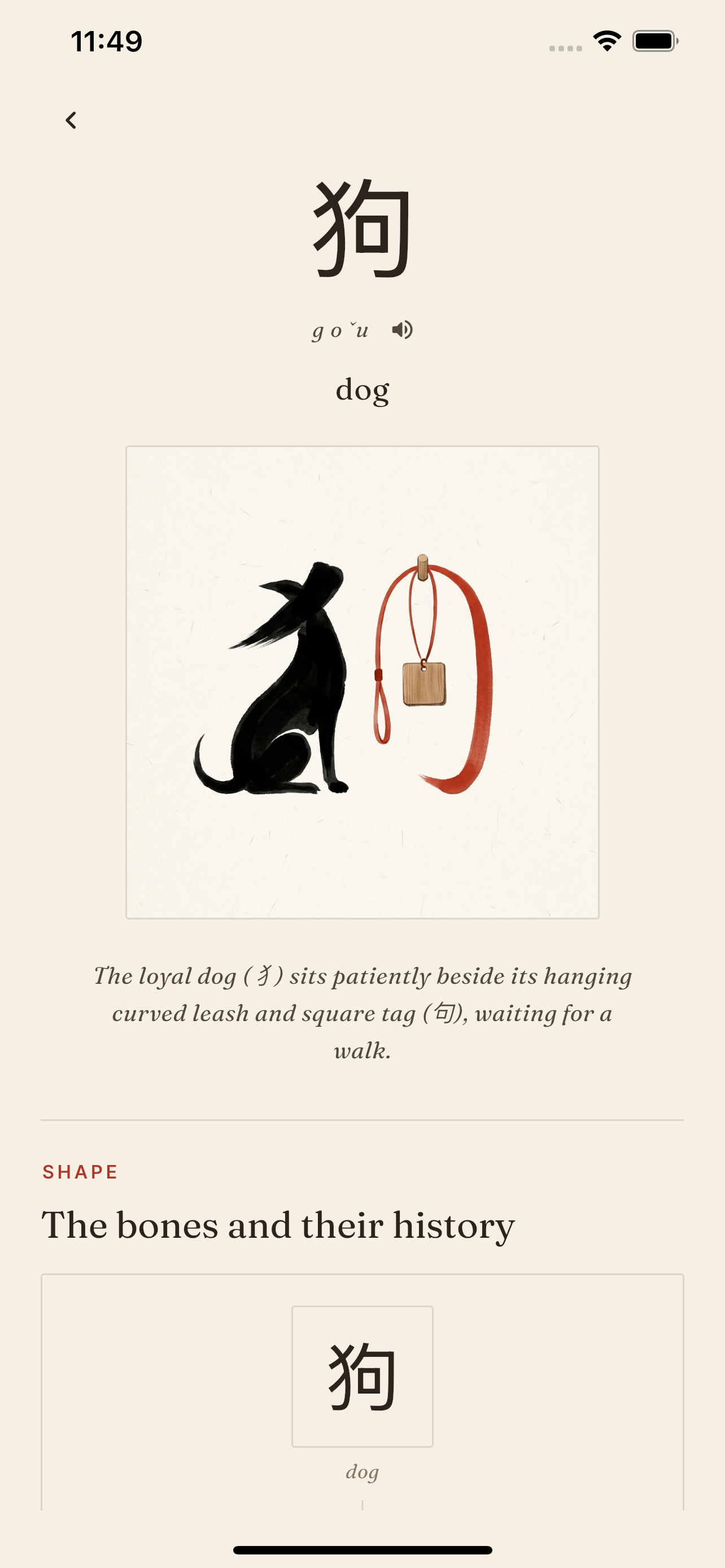
The library covers 1,799 HSK 1–6 characters today (HSK 7 expansion planned), 260 browsable components, 5,300 example words, and 3,562 confusable character pairs. The first 100 characters are free with full functionality; full access is by subscription or a one-time lifetime unlock. No ads, no required account. iOS today, with Android on the roadmap.
InkSeal is the right choice when you want to read Chinese — menus, signs, captions, simple text — and when you specifically do not want to drill stroke order or fight a gamified streak. The longer method writeup is in learn Chinese characters visually. The broader guide to the writing system is at Chinese characters: how they work.
How InkSeal compares to other visual character apps
Three apps occupy the visual / mnemonic character-learning niche. They differ on price, platform, and method.
| App | Library | Price | Platform | Style |
|---|---|---|---|---|
| InkSeal | 1,799 HSK 1–6 | Subscription or lifetime unlock | iOS native | Ink-wash, strokes baked into illustration |
| Zizzle | ~3,000 | $8/mo or $119 lifetime | Web | Cartoon mnemonics, includes handwriting |
| HanziHero | ~3,000 | $9/mo or $79 lifetime | Web | Component-up, textbook-style |
InkSeal is the lowest lifetime cost and the only iOS-native option. The tradeoff is that the library is HSK-scoped at 1,799 today (HSK 7 expansion planned) rather than 3,000+, and the Android version is on the roadmap but not yet shipped. Zizzle suits learners who want handwriting included and have a budget for the higher lifetime price. HanziHero suits learners who want a more analytical, component-led approach.
For DIY flashcards: Anki
Anki is the open-source standard for spaced-repetition flashcards. It is free on desktop and Android, and a $25 one-time purchase on iOS. The catch is that Anki ships empty — you build your own decks or download community decks of variable quality. The strength is total flexibility; the weakness is the time spent curating cards instead of learning.
Use Anki if you genuinely enjoy deck-building and want full control. Use a pre-built app like InkSeal, HelloChinese, or Skritter if you would rather skip the curation and start reviewing.
For graded reading: Du Chinese and The Chairman's Bao
Once you can recognize 500 to 1,000 characters, graded readers unlock the next stage. Du Chinese and The Chairman's Bao both publish HSK- leveled stories with built-in tap-to-translate. They are reading practice, not character-learning apps — pair them with InkSeal or Skritter for the character side.
For the gamified daily habit: Duolingo
Duolingo's Mandarin course exists and works as a daily habit anchor. It is the weakest option in this list for actually understanding the writing system — characters arrive without enough scaffolding — but the streak mechanics are real, and habit is the rate-limiting factor for most learners. Use Duolingo as a habit driver alongside a stronger character or course app, not as the main tool.
The one thing to ignore
Almost every "top Chinese apps" article will list 10 to 20 apps as if you should install them all. You shouldn't. Pick the one tool for your one goal, use it daily for a month, and add a second app only when you hit a specific limit. Five mediocre apps used briefly will teach you less than one good app used consistently.
Frequently asked
- What is the best app to learn Chinese?
- There is no single best app — it depends on your goal. HelloChinese for a beginner course, Pleco for dictionary, Skritter for handwriting, InkSeal for visual character recognition, Anki for DIY flashcards.
- What is the cheapest Chinese learning app?
- HelloChinese has the strongest free tier. Pleco is free for basic dictionary use. Among dedicated character-learning apps, InkSeal lets you learn your first 100 characters completely free before deciding on a plan.
- Is HelloChinese or Duolingo better for Chinese?
- HelloChinese is generally stronger for Mandarin because it is purpose-built for the language, while Duolingo applies the same gamified template across all courses.
- What's the best app for Chinese characters specifically?
- For reading, InkSeal. For handwriting, Skritter. For deep etymology, Outlier Linguistics. For component-led study, HanziHero. The right answer depends on whether you want to read, write, or analyze.
- Is there an Android version of InkSeal?
- Not yet, but it is planned. InkSeal is on iOS today (iPhone and iPad) with an Android version on the roadmap. Zizzle is a web-based option for Android in the meantime.