App comparison
InkSeal vs Zizzle
InkSeal and Zizzle are the two main visual-mnemonic apps for Chinese characters. Both teach hanzi through pictures rather than rote drills. They differ on four things that actually matter: price, platform, scope, and style. This page lays out the honest comparison so you can pick the one that fits.
Side-by-side comparison
| InkSeal | Zizzle | |
|---|---|---|
| Pricing model | Free first 100 chars; monthly / yearly / lifetime | Free HSK 1–2; monthly / yearly / lifetime |
| Platform | iOS today; Android planned | Web app (works in any browser) |
| Library | 1,799 HSK 1–6 today; HSK 7 planned | ~3,000+ characters |
| Focus | Reading and recognition only | Reading + handwriting practice |
| Visual style | Ink-wash, strokes baked into illustration | Cartoon-style mnemonic scenes |
| Free tier | First 100 characters free in the app | Free trial |
| Subscription | No | Yes (or lifetime option) |
| Account required | No | Yes (web account) |
| Works offline | Yes (content bundled in app) | Browser-dependent |
| Android | Planned (not yet released) | Works via browser |
1. Pricing: similar structures, different free tiers
Both apps now use the same structure: a subscription (monthly or yearly) with a one-time lifetime option for people who prefer to own their tools. InkSeal's first 100 formally learned characters are free with full functionality — enough to finish the HSK 1 core before paying anything. Zizzle's free tier covers HSK 1–2 browsing. Current prices for both are listed on their stores.
Zizzle uses a subscription model. Roughly $8 per month or $60 per year keeps your access active, and a lifetime tier sits around $119. The subscription is fine if you finish quickly. Over a typical 2–3 year learning timeline, the monthly plan adds up; the lifetime tier is about four times the cost of InkSeal.
If you prefer paying once and forgetting about it, InkSeal is the lower- cost path. If you want only a short, intense study burst and will be done in months, the monthly tier of either app works.
2. Platform: iOS native vs web app
InkSeal is built natively for iPhone and iPad. The app runs offline, the content (illustrations, etymology, words) is bundled into the app rather than streamed, and the interactions — long-press to reveal, swipe through detail panels — are built around touch. An Android version is on the roadmap but is not yet released.
Zizzle is primarily a web application. It runs in any browser, including Safari on iPhone, but it is not a native iOS app. The advantage is cross-platform reach (works on Android, Mac, Windows today). The tradeoffs are browser dependence, an online requirement for most features, and the slight friction of a web tab versus a home-screen app icon.
Pick InkSeal for a phone-first, offline-capable, native-app experience on iOS. Pick Zizzle if you want to study from a desktop browser or need Android access today.
3. Scope: HSK 1–6 today vs 3,000+
InkSeal covers 1,799 characters specifically scoped to HSK 1 through HSK 6. That is the standard proficiency framework for foreign learners and corresponds to functional literacy in modern Mandarin (around 98 percent of everyday written text). Every character in the InkSeal library is tied to its HSK level, so the path is structured around the official curriculum. HSK 7 expansion is on the roadmap and will widen the library beyond the current HSK 6 ceiling.
Zizzle has a larger total library of roughly 3,000+ characters today. The extra characters extend beyond HSK 6 into less common territory. If your goal is reading native-level news or literature right now, the larger Zizzle library gives more coverage. If your goal is HSK completion or everyday reading fluency, the InkSeal scope matches the target exactly and avoids spending time on characters you will rarely encounter.
Beyond raw character count, InkSeal also bundles 260 browsable components, 5,300 example words, and 3,562 confusable character pairs — structural learning aids that are useful regardless of how big the character library is.
4. Focus: reading-only vs read + write
InkSeal is deliberately reading-only. There is no stroke-order practice, no handwriting trace, no quiz that asks you to draw a character. The design assumes that modern Mandarin learners read and type far more than they write, and that handwriting practice often gets bolted on without enough payoff for beginners.
Zizzle includes handwriting practice alongside its mnemonics. If you are preparing for a handwritten exam, taking a classroom course that requires writing, or you simply enjoy practicing strokes, that matters. If handwriting feels like a chore that slows you down, skipping it (the InkSeal path) is the more efficient route to reading fluency.
For dedicated handwriting practice — better than either of these apps — see Skritter, which is the market leader for that specific job. The longer comparison is in best app to learn Chinese.
5. Visual style: ink-wash vs cartoon
Both apps use illustrated mnemonics, but the visual languages are completely different.
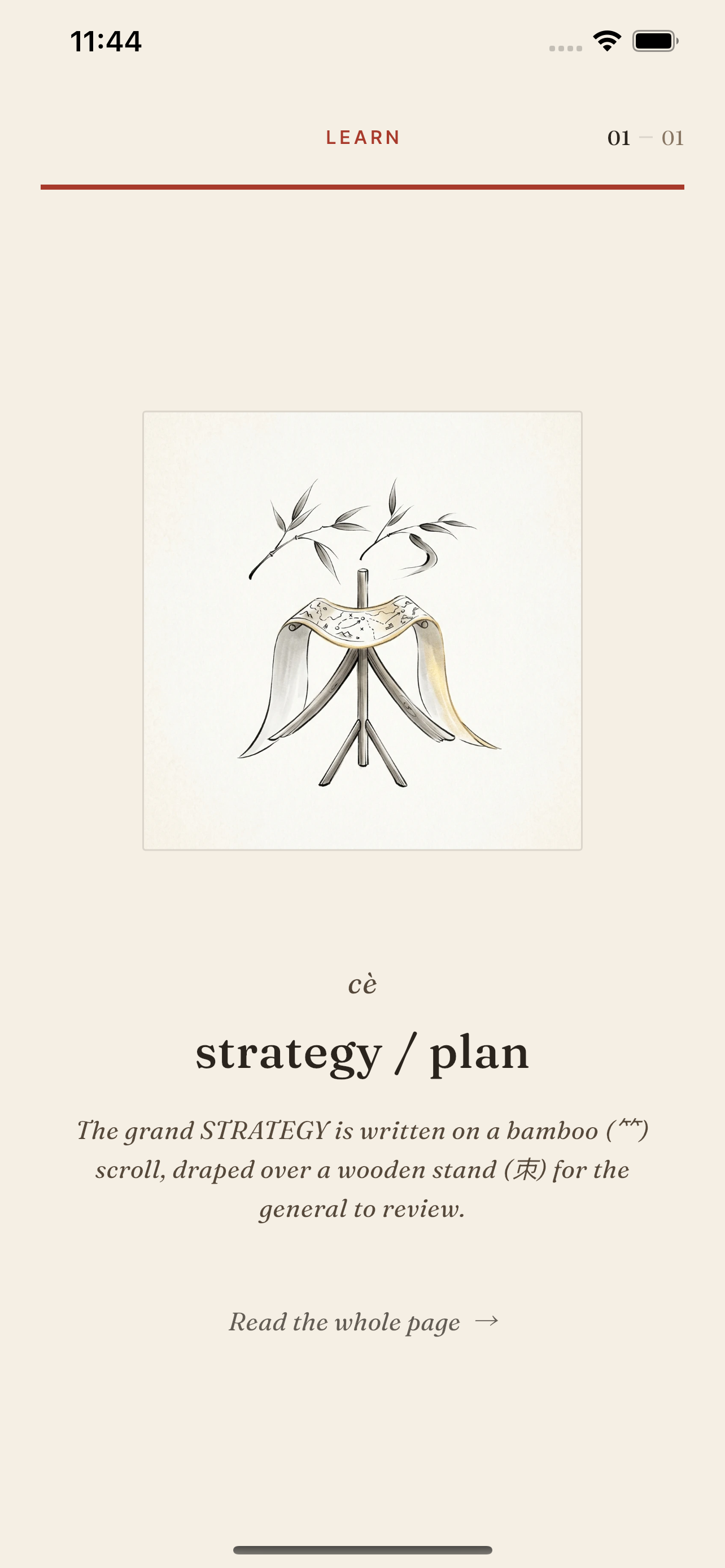
InkSeal uses a quiet ink-wash aesthetic drawn from classical Chinese brushwork. Each illustration is purpose-designed so the character's stroke structure is visible inside the artwork itself — when you look at the picture, you are also looking at the character. The palette is restrained: rice-paper backgrounds, ink black, accent colors used to mark meaning components (warm) and phonetic components (cool).
Zizzle uses a cartoon style with colorful character-driven scenes. The mnemonic story is told through caricatures and props that map to the sound and meaning components of each character. It is more verbose and more playful by design.
Visual taste is personal. Try the free tier of both — InkSeal's first 100 characters in the app, Zizzle's free trial in the browser — and pick whichever style you actually want to look at for a year.
Where each one is the right pick
Pick InkSeal if you want…
- An iOS-native app rather than a browser tab (Android version on the roadmap)
- The option to buy a lifetime unlock and never see another charge
- HSK 1–6 coverage matched exactly to the proficiency framework, with HSK 7 expansion planned
- A calm, minimal aesthetic without gamification
- To skip handwriting and focus only on reading and recognition
- Offline access without an account
Pick Zizzle if you want…
- A larger character library (~3,000+) extending beyond HSK 6 today
- Built-in handwriting practice as part of one app
- Cross-platform access right now (desktop browser, Android, etc.)
- A cartoon-style, more verbose mnemonic system
- A subscription option for short-term study
What we did not compare
A serious comparison would also cover lesson sequencing, review algorithm, audio quality, and content beyond characters (vocabulary decks, grammar notes, listening). Both apps handle these reasonably, but they are second-order factors compared to the four above. If you pick the wrong app on price or platform, the review algorithm cannot save you.
For the broader context — where InkSeal and Zizzle fit alongside HelloChinese, Pleco, Skritter, Anki, and Duolingo — see best app to learn Chinese. For background on how Chinese characters are actually built, see Chinese characters: how they work.
Frequently asked
- How do InkSeal and Zizzle prices compare?
- Both offer monthly, yearly, and lifetime options — check each store for current prices. InkSeal's free tier (100 characters with full functionality) lets you evaluate the method thoroughly before paying.
- Does Zizzle work on iPhone?
- Yes, via Safari, but Zizzle is a web app, not a native iOS app. InkSeal is built natively for iOS.
- Which has more characters?
- Zizzle today (~3,000+). InkSeal is scoped to 1,799 HSK 1–6 characters, which matches the standard proficiency framework exactly. HSK 7 expansion is on the InkSeal roadmap.
- Does InkSeal include handwriting like Zizzle?
- No. InkSeal is deliberately reading-only. Zizzle includes handwriting practice.
- Can I try both before paying?
- Yes. InkSeal's first 100 characters are free in the iOS app. Zizzle offers a free trial of its web app.