Hanzi guide
Chinese characters: how they work and how to learn them
Chinese characters look intimidating at first because they seem to have no pattern. They do. This guide explains what a character actually is, how the writing system is organized, and a practical learning order that respects how your memory works.
What is a Chinese character?
A Chinese character is one written unit that usually represents one syllable and carries meaning. 山 means "mountain" and is pronounced shān. 木 means "tree" and is pronounced mù. A character is not a word in the English sense — many Chinese words are written with two characters together — and it is not a letter either. The most accurate label is "logograph": a symbol that stands for a unit of meaning.
The same character can be used across Mandarin and Cantonese, with completely different pronunciations. Historically, Chinese characters were also adopted into Japanese (where they are called kanji) and Korean (where they are called hanja). The shapes are shared. The sounds are not.
How many Chinese characters are there?
The Hanyu Da Zidian, the largest Chinese-language dictionary in print, contains over 60,000 characters. Almost all of them are historical, technical, or extremely rare. For modern reading the numbers are much smaller.
| Characters known | Approximate coverage of written text |
|---|---|
| 100 | ~42% |
| 500 | ~80% |
| 1,000 | ~91% |
| 2,000 | ~97% |
| 2,500–3,000 | ~98–99% (functional literacy) |
A literate native adult typically recognizes 4,000 to 6,000 characters, but actively writes far fewer. For foreign learners, the standard reference is HSK, the Chinese proficiency framework, which covers about 2,663 characters across HSK 1 through HSK 6.
How a character is built
Strokes
Every character is drawn from a small set of basic strokes — horizontal, vertical, dot, hook, and a handful of curves. Stroke counts range from one (一, "one") to over thirty for rare archaic characters. Most everyday characters have between 4 and 15 strokes. Stroke order matters when writing by hand, but reading does not depend on it.
Components and radicals
Most characters are made of two or more recurring sub-shapes called components. The 214 traditional Kangxi radicals are the most widely cited inventory; modern dictionaries trim this to about 200. Around 50 components appear so often that learning them early pays back across hundreds of later characters. 氵 means water and appears in 河 (river), 海 (sea), 江 (river), 湖 (lake), 洗 (wash), 流 (flow), and many more. Once your eye knows 氵, those characters stop being unrelated drawings. The full beginner list is in Chinese radicals for beginners.
The four character types
Traditional Chinese philology classifies characters into four types based on how they were formed. Understanding which type a character belongs to changes how you remember it.
| Type | Share | Example | How it works |
|---|---|---|---|
| Pictograms (象形) | ~5% | 山 mountain · 月 moon · 火 fire | The shape is a stylized picture of the thing itself. |
| Indicatives (指事) | ~1% | 一 one · 上 up · 下 down | Abstract concepts shown by a positional or numerical mark. |
| Compound ideograms (会意) | ~5% | 休 rest = 人 person + 木 tree | Two meanings combined into a third by logical metaphor. |
| Phono-semantic compounds (形声) | ~80–90% | 妈 mā (mother) = 女 woman + 马 mǎ (horse, phonetic) | One component hints at meaning, the other hints at sound. |
The dominant pattern — by a long margin — is the phono-semantic compound. Once you can spot the meaning side and the sound side inside a new character, you can often guess both what it means and how it is roughly pronounced.
Simplified vs traditional
Two written forms of the same characters are in active use today. Simplified characters (简体字) were standardized in mainland China in the 1950s and 1960s to reduce stroke counts and improve literacy rates. Traditional characters (繁體字) remain standard in Taiwan, Hong Kong, and Macau, and are used by many overseas Chinese communities. About 2,000 characters differ between the two; the rest are identical.
Examples: 听 (simplified) and 聽 (traditional) both mean "to listen." 国 and 國 both mean "country." 学 and 學 both mean "to study." For beginners targeting HSK, mainland Chinese media, or most modern apps, learn simplified first. Traditional is a smaller add-on once the simplified foundation is in place.
How Chinese characters work as a writing system
Chinese is read left to right, top to bottom, in modern usage. Older texts and some artistic contexts run top to bottom in columns ordered right to left. There are no spaces between words; the reader segments by recognizing character compounds. Punctuation is fully developed in modern Chinese, with both Latin-style punctuation and a few Chinese-specific marks like the enumeration comma (、) and the title brackets (《》).
A "word" in Chinese is usually one or two characters. 中 (middle) and 国 (country) combine into 中国 (China). 学 (study) and 习 (practice) combine into 学习 (to learn). Once you know individual characters, picking up compound words is mostly free.
A realistic learning order
- Pinyin and tones (1–2 weeks). Pinyin spells out Mandarin pronunciation using Latin letters and four tone marks. It is not the writing system but you need it to look up and pronounce any character.
- The top 50 components (2–3 weeks). Learning the most frequent components first means every later character looks like familiar parts. See Chinese radicals for beginners.
- The first 500 characters (2–4 months). These alone cover about 80 percent of common reading. Pair every character with a visual mnemonic and a spaced-repetition review so the shape sticks.
- HSK 1 through 6 (1–3 years at a calm pace). The HSK path takes you from beginner to functional literacy at 2,663 characters. See HSK character learning.
Why visual mnemonics matter
The wall most learners hit around character 200 is that pure rote drilling stops working. A character is a shape with internal structure, and treating it as a string of letters or strokes to memorize is what makes it feel arbitrary. Visual mnemonics solve this by giving the shape a reason. When 休 is drawn as a small person leaning against a tree, "rest" becomes something you can see rather than something you have to memorize.
The longer technique writeup lives in learn Chinese characters visually.
Where InkSeal fits
InkSeal is an iOS app for English-speaking beginners who want to recognize Chinese characters. Every character in the library is paired with a purpose-designed ink illustration that keeps the character's shape visible inside the artwork. You long-press a character, the picture fades in, and the meaning is suddenly something you can see.
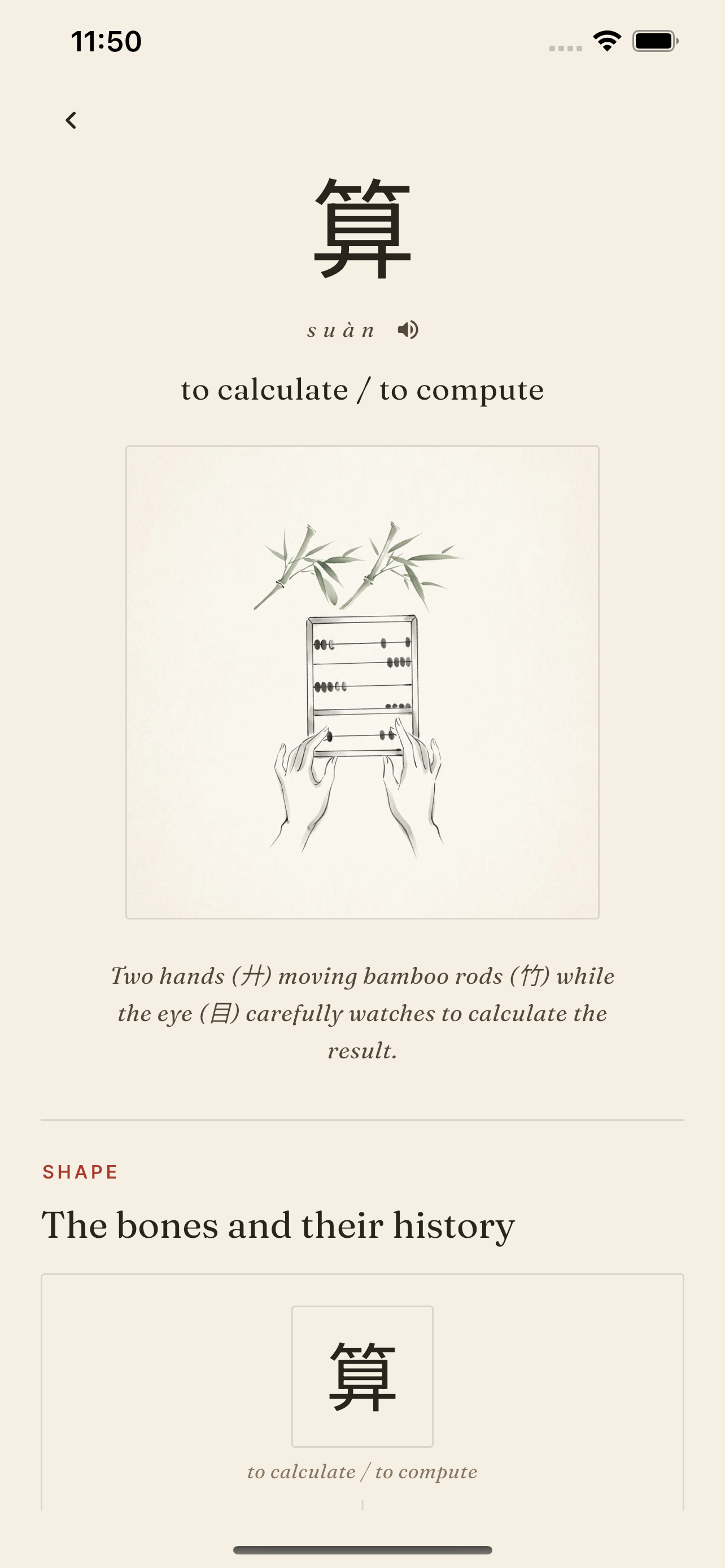
The library covers 1,799 HSK 1–6 characters today (HSK 7 expansion planned), 260 browsable components, 5,300 example words, and 3,562 confusable character pairs. The first 100 characters are free with full functionality; full access is available by subscription (with a free trial on the yearly plan) or a one-time lifetime unlock. There is no advertising and no required account. The app is on iOS today (iPhone and iPad); an Android version is on the roadmap. For comparison against other tools, see best app to learn Chinese.
Frequently asked
- What are Chinese characters called?
- Hanzi (汉字) in Mandarin. The same characters are called kanji in Japanese and hanja in Korean.
- How many Chinese characters are there?
- Over 60,000 in the largest dictionary, but only about 2,500 to 3,000 are needed for everyday reading. HSK 1 to 6 covers about 2,663.
- What is the difference between simplified and traditional?
- Simplified characters (used in mainland China) have fewer strokes than traditional characters (used in Taiwan, Hong Kong, Macau). About 2,000 characters differ; the rest are identical.
- Are Chinese characters the same in Mandarin and Cantonese?
- Yes for the written form. No for pronunciation. A Mandarin and Cantonese speaker can read the same newspaper but cannot converse.
- How long does it take to learn Chinese characters?
- The first 500 characters take 2 to 4 months at a calm pace and unlock about 80 percent of everyday reading. The full HSK 6 level of 2,663 characters typically takes 1 to 3 years.